

Ask new officers about onboarding while the details are fresh enough to fix. A short check-in in the first week catches missing access and unclear instructions. A second after the first month shows whether employees can find help without asking the same person every time. Use a later check-in to see whether handoffs and expectations are clear as responsibilities change.
TL;DR
Survey new officers around days 7, 30, and 60. Change the questions as their needs change. Give equipment, account access, and payroll issues a faster route than the survey. Review themes across hiring groups without turning the responses into probation evaluations.
Day 7: Check whether the basics worked
On the first morning, can a new employee find the right building, contact the right person, and get into the systems they are expected to use? A welcome presentation does not tell you whether the account activation message arrived, someone showed them how to log hours, or their supervisor knew they were starting.
Ask three concrete questions: “Did you know where and when to report on your first day?” “By the end of the first week, which required tools or accounts were still unavailable?” and “If you had a question about pay or timekeeping, would you know whom to contact?” In the access question, list broad categories rather than the names of restricted systems. For a problem that still needs correction, provide the help desk, equipment office, or payroll route separately. Some new hires will wait until the next survey to raise a problem if the invitation makes that sound like the only route.
Day 30: Check whether new hires can find answers
Ask about the job as people are experiencing it. “In the past two weeks, how easy was it to find the current instructions for a task you were expected to perform?” tests whether the reference materials work. “How clear were your supervisor’s expectations for this stage of onboarding?” tests whether the employee knows what to focus on next. An optional prompt such as “Which routine process needed a clearer explanation?” can help identify the part of the checklist to rewrite.
The U.S. Office of Personnel Management’s orientation guidance treats orientation as a process with information delivered at useful points in an employee’s first year. Police agencies can apply that principle without copying a federal timetable. A lateral hire might need local systems and policy context sooner than a recruit still in the academy. A dispatcher or records employee may have a different transition date altogether.
Day 60: Find the gaps in handoffs
By the third survey, shift from “Did this arrive?” to “Is the next step clear?” Ask: “Did you know who was responsible for your next handoff or assignment?” “How clear was the feedback you received about what to practice next?” and “What should someone starting in your role receive earlier?” Use a “Not yet applicable” option when a field assignment or work transition has not happened. If a milestone slips, note it in the reporting plan rather than interpreting missing answers as dissatisfaction.
Take action without putting individuals on display
Assign someone in onboarding to sort the feedback into three lanes: problems that can be fixed now, revisions for the next hiring group, and items that need a policy or budget decision. Set dates for each. As a hypothetical example, several new hires report that radio assignments were clear but uniform fittings had to be rescheduled. The coordinator can add a fittings appointment confirmation to the pre-start checklist instead of adding another orientation session.
A class of three is small enough that a direct quote or a combination of start date, job, and location could identify someone. Explain who can see responses, avoid asking for identifying information you do not need, and combine hiring groups before sharing results when necessary. Keep performance evaluations in the formal process. Tell respondents where to report urgent safety matters, payroll problems, or misconduct separately.
Start with Officer Survey’s newly hired police officer onboarding questions. If you want to see how to build different questionnaires for each milestone, request a demo.
Frequently asked questions
Should the same questions go to every new employee?
Keep a few shared items, such as clarity of expectations and ability to find support. Add role-specific questions only when your team can act on the answer and can report it without exposing one person.
Should the direct supervisor see individual comments?
Set access before launch and tell employees exactly who can view responses. Summarized feedback is usually enough to fix shared onboarding problems. Use established channels for individualized support or performance conversations.
What if the agency hires only one officer at a time?
Offer a direct check-in for issues that need immediate attention. For survey reporting, accumulate enough responses across hiring periods to protect identities and describe the time period covered.
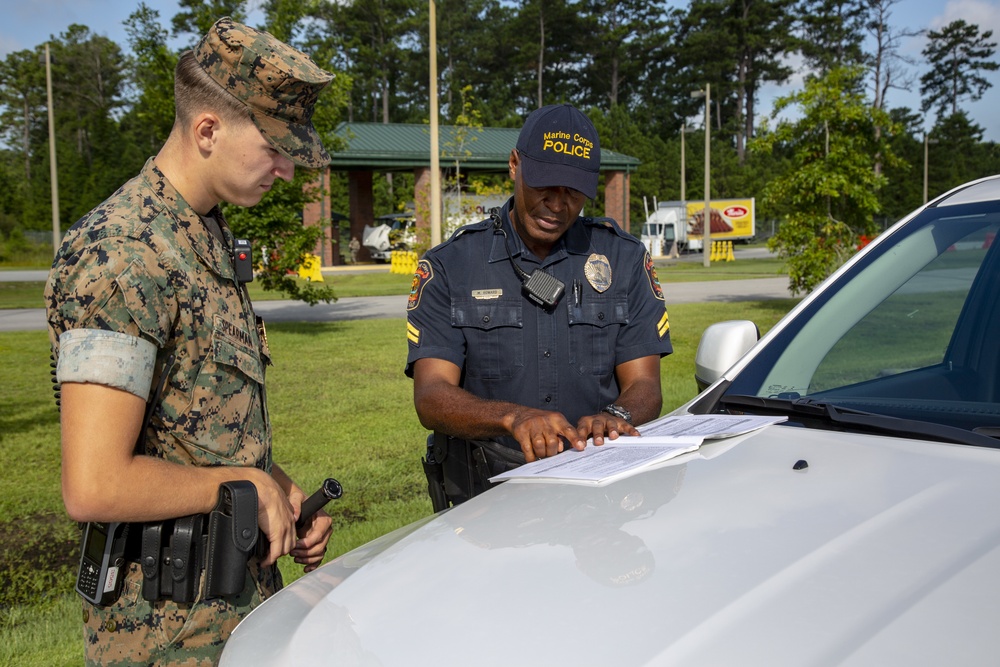
Header photo: A civilian police officer instructs a military police officer at Marine Corps Air Station New River. U.S. Marine Corps photo by Lance Cpl. Isaiah Gomez, via DVIDS, public domain. The photo is illustrative and does not imply endorsement.